For church operators and multi-institution providers: operator–institution settlement, management of normative and church supplementary support, KENYSZI integration, document and process management prepared for official audits — in a single system.
At church and civil social providers, the operator finances several institutions with their own tax numbers in parallel. The largest part of revenue comes from state sources, so continuous control of usage and provable settlement are required.
The platform covers the entire vertical of the social-care pyramid — from elderly care through the foster-parent network to outpatient specialist care.

Residential and day care, management of normative support calculated by the number of people cared for.

Automatic tracking of the 30-day and other statutory deadlines, financing-risk alerts.

Public-education teacher support, headcount-based normative settlement, EDR integration.

Dynamic support management for fostered children by normal and special educational needs, with retroactive-modification support.

Fulfilment of reporting obligations, daily tracking of the number of people cared for.

Physician support per healthcare legislation, management of patient traffic and performance indicators.
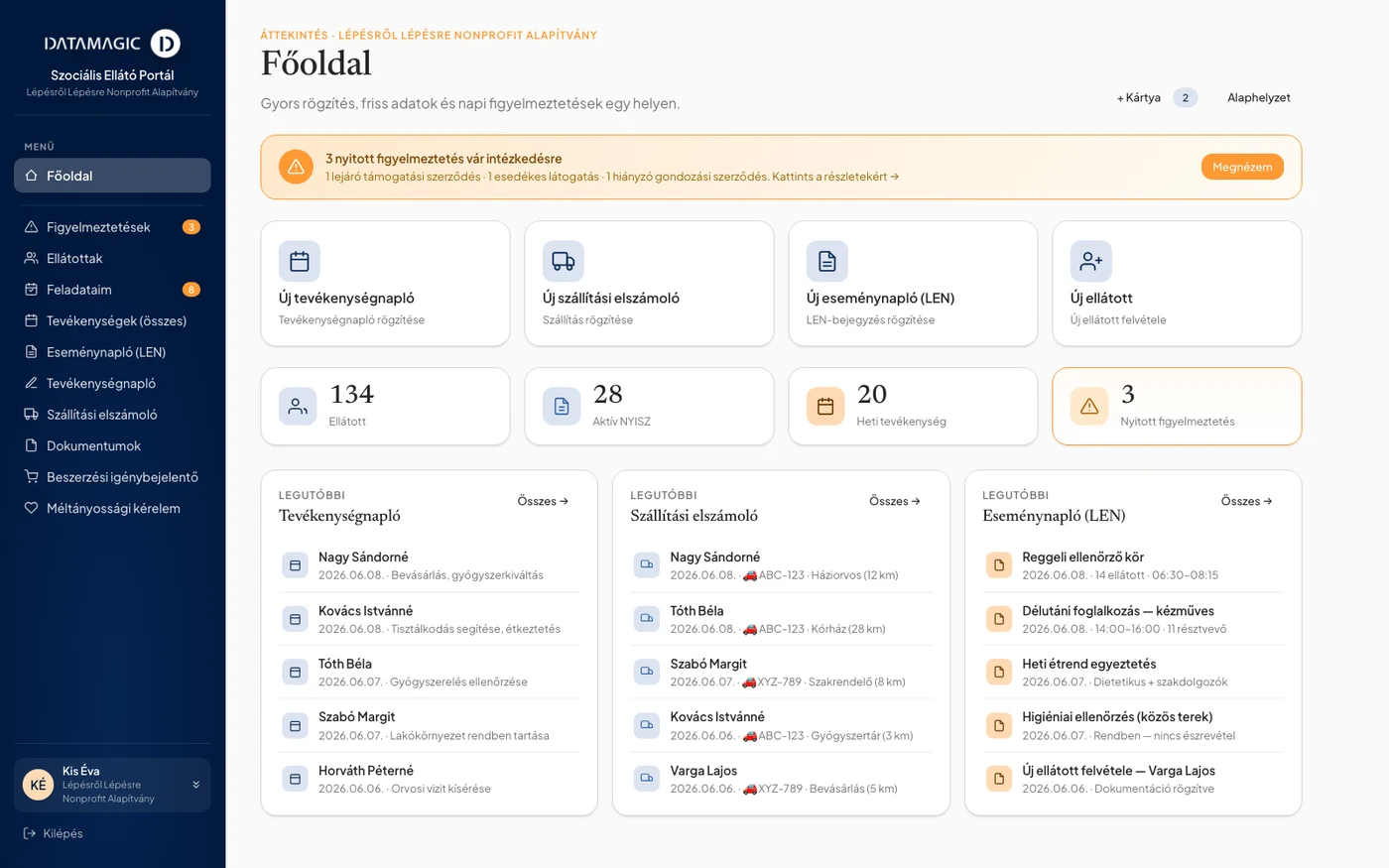
The platform consists of two interface layers that work on the same database. Institutional users handle back-office processes through DataMagic ERP; colleagues working off-site record and read via the Social Portal — from any modern smartphone, tablet or browser. All data in one place, every user sees the same thing in real time.
Institutional back-office system
Off-site fieldwork
The operator receives the state normative and the church supplementary support as an internal church legal entity. The platform automatically handles the pass-through obligation, inter-institution settlement and full consolidation.
Money flow between the operator and the institutions with their own tax numbers along a document chain — similar to the corporate parent-company–subsidiary model.
The normative support received by the operator must be passed on 100% to the institutions concerned — the system generates and tracks this automatically.
The church supplementary support can be distributed flexibly, according to the institutions' maintenance needs. The platform supports this in a rule-driven way.
The entire organization's financial and professional data in a single, consolidated view — with this the operator can report to the Hungarian State Treasury.
Normative, church supplementary, sectoral wage supplement, utility subsidy and care fee — each with its own rule set, but in a common document chain and management report.

Social, public-education and healthcare normatives. Tracking of usage obligations per legislation.

Moves together with the normative. Its use is more flexible, but it must also be settled in a provable way.

Separate handling of wage-type supplementary support, traceable at employee level.

Support that can be used for operating costs, with settlement per utility item.

Own revenue the operator can manage more freely — the system handles it separately.

Breakdown by institution and service type — based on corporate profit-center logic.
Social providers must report daily the care data to the KENYSZI (Central Electronic Register of Service Users) system. At most organizations this is currently done by hand, tying up staff time.
The DataMagic platform synchronizes automatically with KENYSZI and the related government-office systems — the daily administrative load drops, data integrity rises, and we get a full picture of client life paths.
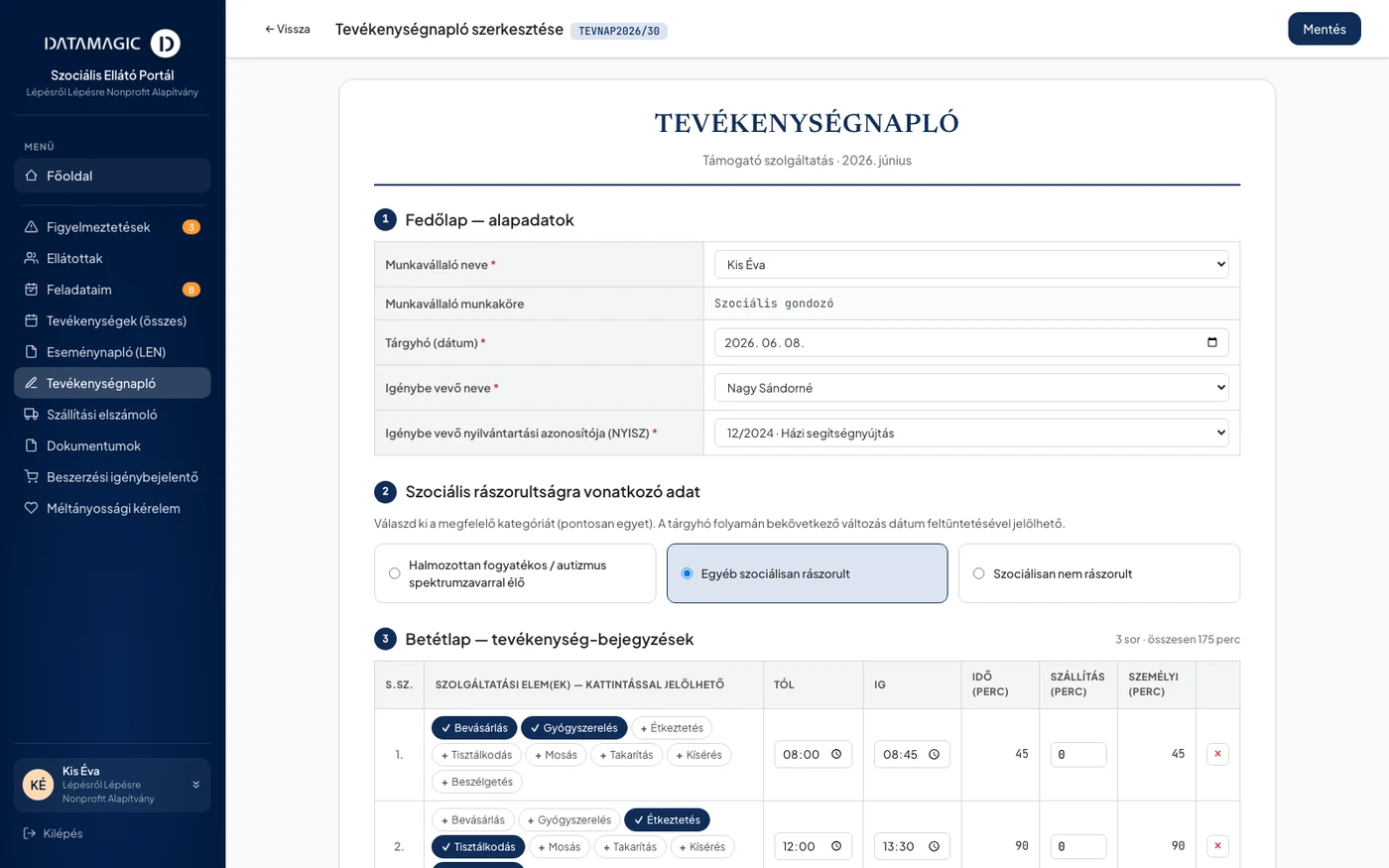
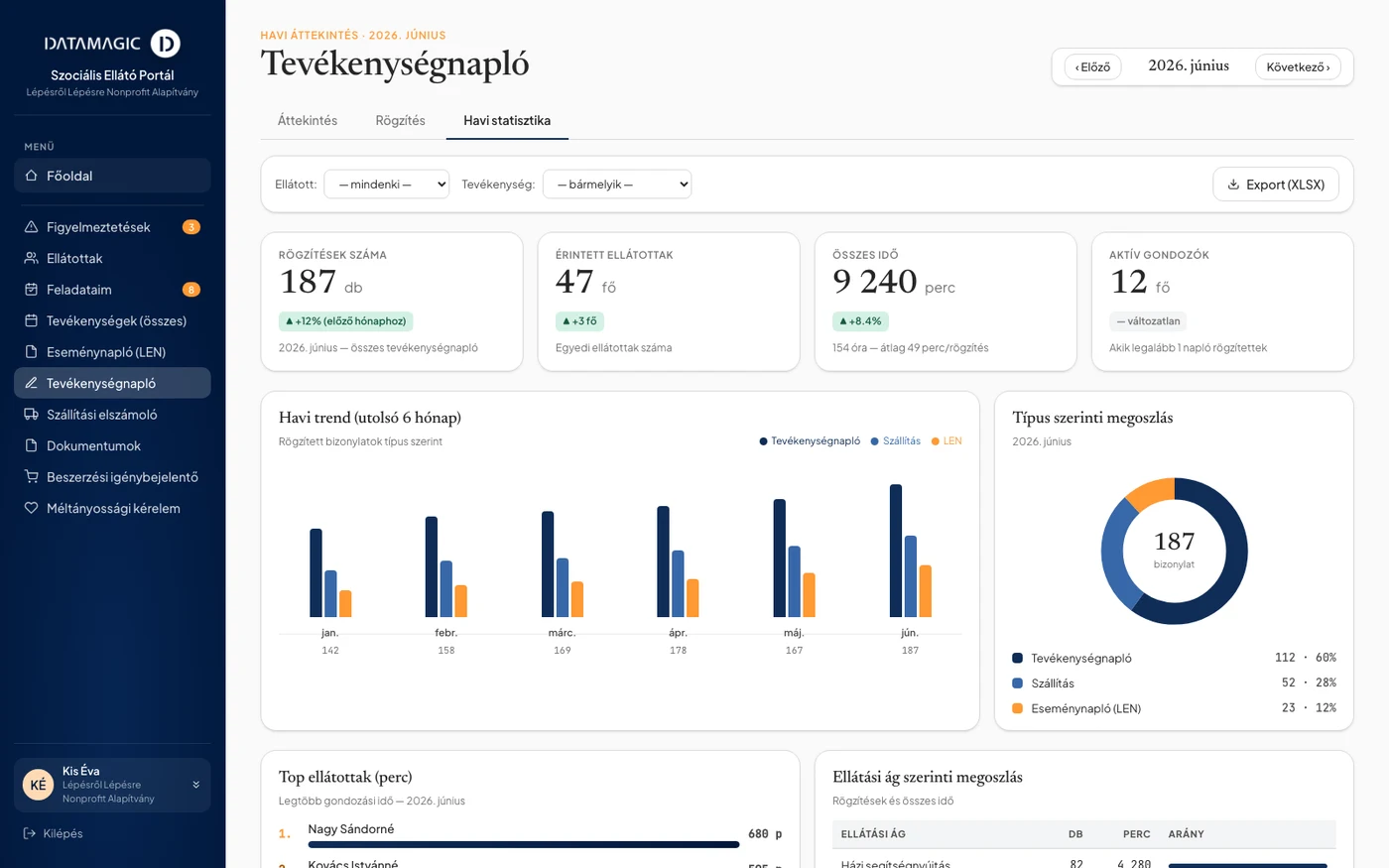
Social professionals record daily activity from a tablet or mobile at the service location. Entries go to the central database immediately; management receives monthly statistics on the distribution by type, care branch and employee.
An invoice scanned at the secretariat is filed automatically, then passes through the approval chain — accounting only receives the approved items.
Approval at institution-head, operator and finance-director levels, with a configurable rule set — by amount, cost center or service.
Care contracts, employment contracts, procurement documents — with version tracking and expiry reminders.
Every two years the Hungarian State Treasury's auditors can review every normative and church supplementary item. The system's documents can be retrieved retroactively for any point in time.
If repayment obligations emerge at year-end, items can be re-posted in a programmed way from one support type to another — keeping the document chain.
Managers can see at any moment how they stand in terms of financing and effectiveness — by institution, by service type, together with the normative-usage status of the given period.
The system shows exactly when the normative support is covered — from then on the accountants work against the church supplement.
A given client may use several services — the system shows all of them in a unified card-like view.
Performance-linked financing items (e.g. the visit obligation in addiction care) can be tracked automatically.
If under-performance or incorrect usage endangers the support, the system warns in time — before the repayment obligation.
Comparing institutions' performance by cost and revenue — decision support for the operator.
The documents for the biennial mandatory settlement are continuously ready — no last-minute assembly needed.
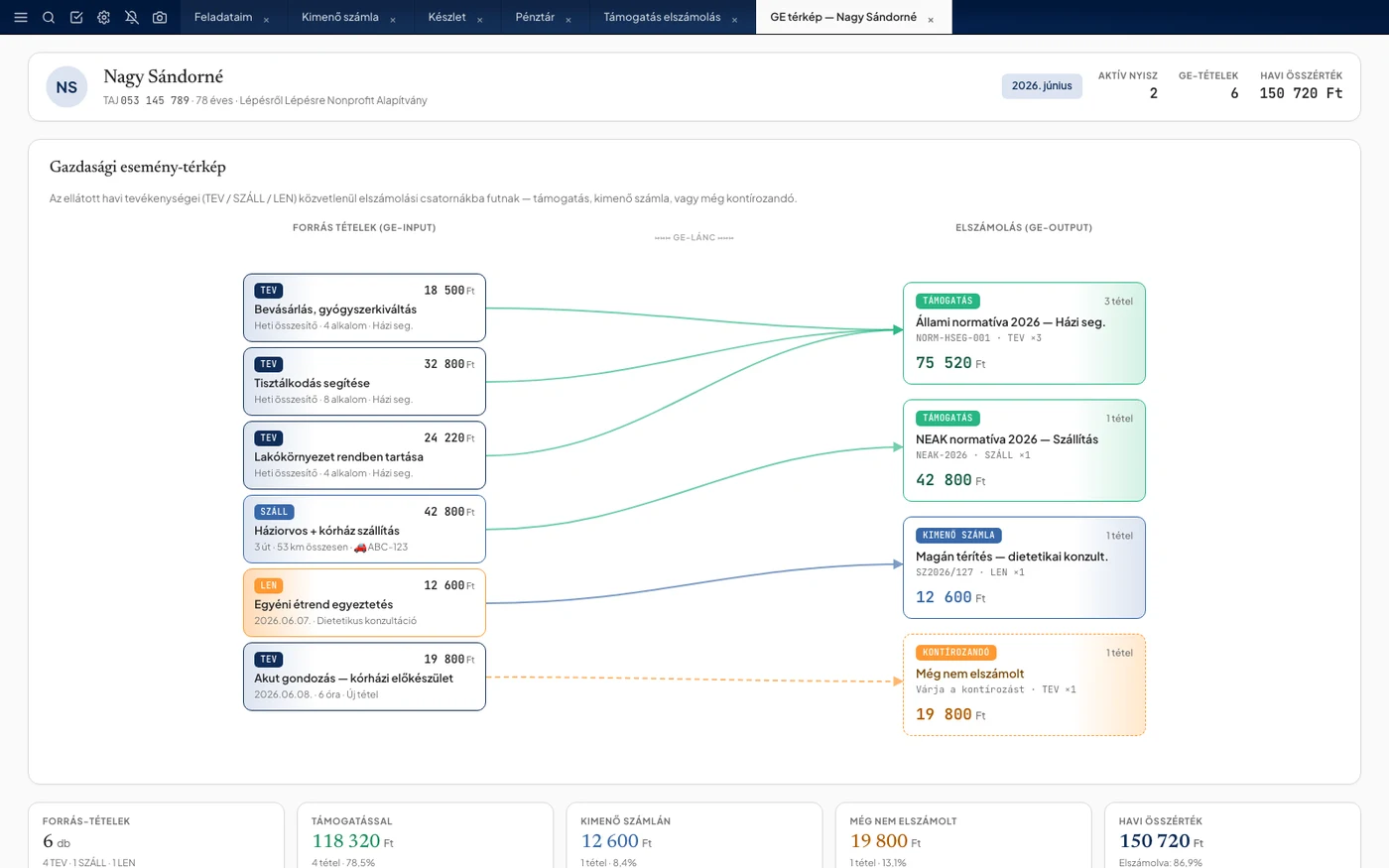
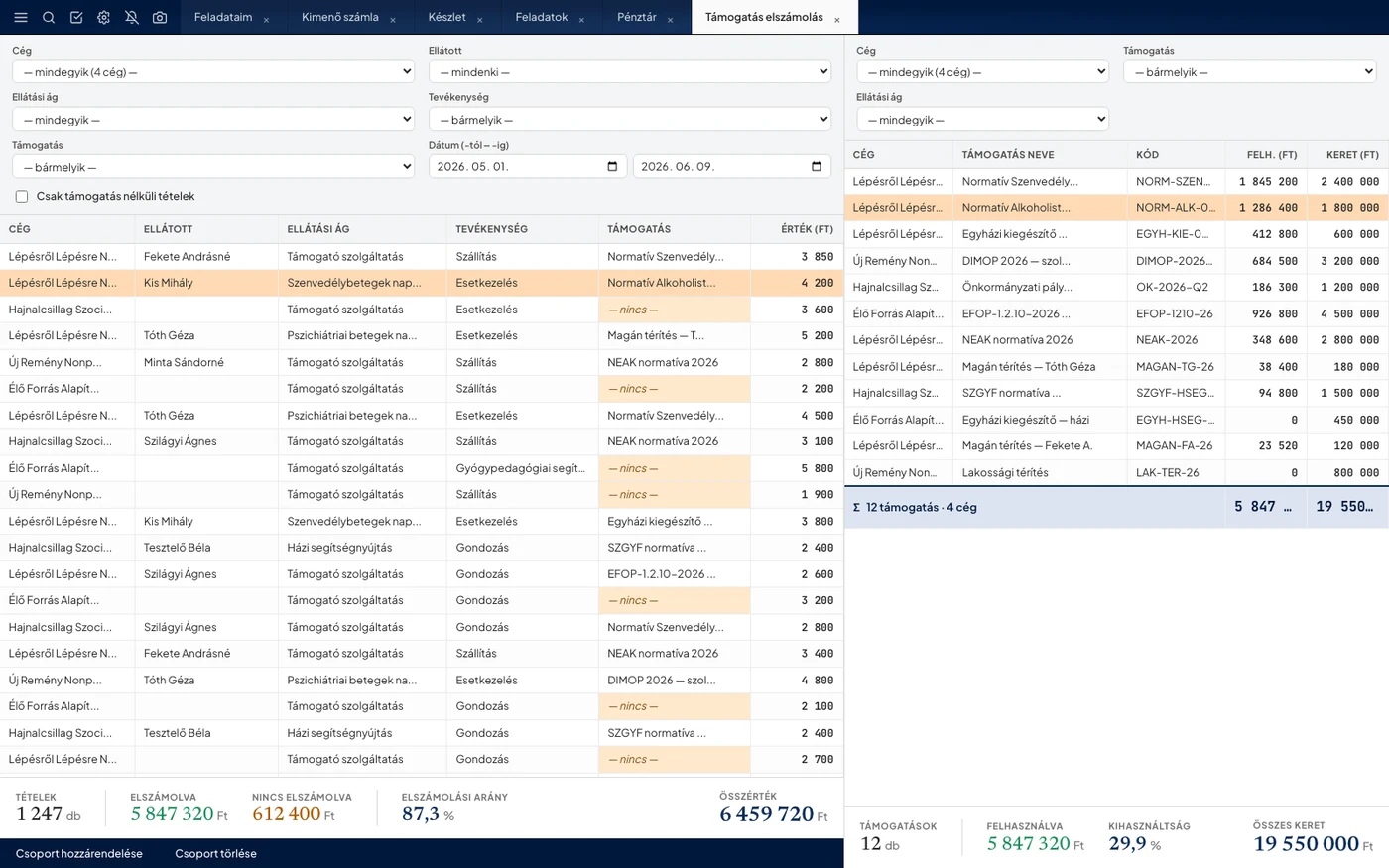
The economic-event map maps each client's monthly activities (activity log, transport settlement, event log) directly to the settlement channels: state normative, NEAK normative, outgoing invoice or “not yet settled” status. The visual EE chain instantly shows which items can go to support and which need posting.
The legal environment of social care changes frequently. The platform's automations help keep pace — retroactive modifications, deadline alerts and audit logs everywhere.
E.g. a fostered child's educational need is modified retroactively — the system supports re-posting back 2–3 months, with automatic settlement of the support difference.
For example the 30-day rule for addiction patients: the system automatically indicates which clients must be recalled to retain the financing.
On a new law or normative change, the system can be adjusted by updating the parameters — without development.
Every modification, approval and document attachment is traceable — a system prepared for procurement and official audits.
In the social sector, the data handled about clients fall into a special category — they concern health, legal-status and financial information at once. The platform meets the requirements of both EU 2016/679 (GDPR) and EU 2022/2555 (NIS2) built into the system's foundations.
Handling of personal and special data
Cybersecurity and business continuity
Church operator, civil social provider, multi-institution organization — send a message and a colleague with experience in the social field will get in touch with you.
Contact us